Postwar Argentina as a Nazi refuge
The Disappearance of Josef MengelePostwar Argentina as a Nazi refuge was not simply a destination reached by fugitives after the Second World War; it was a political and social environment that helped them enter, find allies, and evade accountability. Under Juan Perón, official assistance and organized escape routes intersected with expatriate networks and local institutions. The refuge was never entirely secure: pursuit across borders exposed how protection depended on political choices, personal connections, and the slow, uneven machinery of extradition.
Political welcome and escape infrastructure
In the late 1940s, Juan Perón opened Argentina to thousands of Nazis, Fascists, and collaborators, including soldiers, engineers, scientists, technicians, and doctors. The government invited former enemies of the Allies to contribute to projects ranging from dams and missiles to nuclear power plants, presenting their expertise as a means of strengthening the country. The policy joined practical recruitment to a broader political ambition: to make Argentina an independent power in a world divided by the Cold War.
Juan Perón personally oversaw the escape arrangements. He established an Information Office in Buenos Aires, headed by Rudi Freude, son of Ludwig Freude, a wealthy Nazi banker and an important backer of Perón’s 1946 presidential campaign. Carlos Fuldner, a former SS captain, was dispatched through Spain and Switzerland to Rome and Genoa. Together, Freude and Fuldner helped organize the Nazi Ratlines: networks of diplomats, officials, intelligence figures, and clergy who enabled fugitives to move across borders and obtain new lives. These routes turned refuge into a coordinated process rather than a matter of chance, although they relied on a shifting chain of intermediaries and official cooperation.
In July 1949, Perón extended amnesty to people who had entered the country under false identities and sometimes received them at Casa Rosada. The policy offered a route from concealed arrival toward public acceptance. It also showed that the refuge was sustained not only by covert networks but by decisions made at the highest levels of government.
A political community in Buenos Aires
Buenos Aires became a meeting place for the remnants of the Black Order and a much wider collection of European authoritarian movements. Nazis lived alongside Croatian Ustaše, Serbian ultranationalists, Italian Fascists, Hungarian members of the Arrow Cross Party, Romanian Iron Guard legionnaires, Vichy French, Belgian Rexists, Spanish Falangists, and fundamentalist Catholics. The city’s expatriate milieu included former perpetrators, political exiles, and adventurers; its variety gave fugitives a community in which old allegiances could be renewed and practical help exchanged.
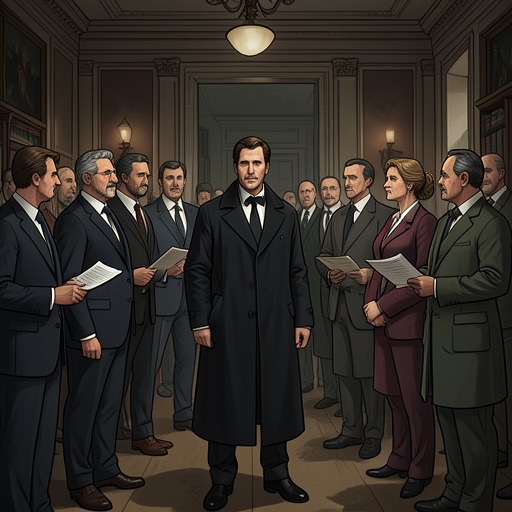
A gathering aboard the Falken made that social world visible. Sassen brought Josef Mengele, then using the name Gregor, into a gathering of European exiles. Among those present were Ante Pavelić, Simon Sabiani, Vittorio Mussolini, Carlo Scorza, Robert Pincemin, Eduard Roschmann, and the physicist Ronald Richter, who had Perón’s support for research into nuclear fusion. Mengele also encountered Reinhard Kopps and Josef Schwammberger, as well as Gerhard Bohne, an administrator of the Nazi euthanasia program whom he had known from Auschwitz. The gathering linked people with different national backgrounds through shared political loyalties and access to the new country’s influential circles.
The community was held together by more than nostalgia. Pierre Daye had helped establish the National Socialist Centre in Buenos Aires, a group of Rexists, Fascists, and Ustaše that opposed American capitalism and Soviet communism and campaigned for amnesty for imprisoned war criminals. In his address to the gathering, he framed their cause as a union of Nazism and Christianity and presented Perón’s Argentina as a counterweight to the United States. Such language converted refuge into a political project: exile was described not as retreat but as preparation for renewed influence.
Support networks and everyday shelter
The refuge operated through personal relationships as well as institutions. Gerard Malbranc, a former Nazi spy and wartime arms dealer, was a prominent figure in Buenos Aires’s Nazi social world. After meeting Malbranc aboard the Falken, Mengele moved into his villa in Florida Este. Malbranc’s home offered comfortable accommodation and a stable domestic setting, while regular visitors such as Eberhard Fritsch and Willem Sassen maintained the connections through which the expatriate community circulated.
Uli Rudel supplied a different kind of assistance. An adviser to Perón, he was involved in the development of the Pulqui II jet fighter with Kurt Tank and acted as an intermediary between Argentina’s air force and German industrial companies. Rudel also helped organize the Kameradenwerk, which sent parcels to imprisoned comrades and paid their legal fees. His role joined professional influence in Argentina to continuing support for former Nazis in Europe. He took Mengele under his protection and warned him not to discuss a rumored Nazi treasure, an episode that shows how silence itself became part of the community’s code.
For Mengele, this network provided shelter, contacts, and a measure of normality, but not immunity from investigation. Hermann Langbein, a former prisoner of Dachau and Auschwitz and a co-founder of the International Auschwitz Committee, patiently gathered evidence and followed the trail of Mengele’s divorce proceedings. On 25 February 1959, a prosecutor in Freiburg im Breisgau, Mengele’s last registered address in Germany, issued an arrest warrant for multiple cases of premeditated murder and attempted murder. Langbein then pressed for West Germany to seek his extradition from Argentina.
Borders, bureaucracy, and the limits of protection
The extradition effort encountered delays at each stage. The request passed through Argentine and West German diplomatic and legal offices, while officials hesitated and procedural obstacles accumulated. By the time the Argentine government might have acted, Mengele had fled to Paraguay. Uli Rudel helped him obtain Paraguayan citizenship in November 1959, despite the fact that the residency requirement had not been met. The Paraguayan Supreme Court issued him citizenship, a residence permit, a certificate of good behaviour, and an identity card. The transition shows both the reach and the limits of the Argentine refuge: a fugitive could move onward when pressure mounted, while another government’s citizenship policy created a fresh obstacle to extradition.
The broader system also depended on the uneven resolve of states pursuing fugitives. West German authorities took years to send fingerprints to South American embassies, and Bonn devoted no special agents or spies to finding Mengele. In 1962, West Germany requested his extradition from Paraguay. President Alfredo Stroessner refused to cooperate, invoking the protection owed to Paraguayan citizens and muddying the trail after Rudel informed him that Mengele had gone to Brazil. In 1963, Chancellor Konrad Adenauer offered a substantial aid incentive for Paraguay to deliver the doctor, but Stroessner would not accept the proposal. The episode made sovereignty both a legal barrier and a political instrument of protection.
In 1964, while the Frankfurt Auschwitz trials drew international attention, West Germany publicly identified Mengele as a Paraguayan citizen living in the tri-border region and traveling to Brazil. Its ambassador asked Paraguay to strip him of citizenship because it had been obtained fraudulently. Stroessner rejected the demand and warned against foreign interference. Fritz Bauer announced a reward for Mengele’s capture, but Paraguay’s interior minister denied that the fugitive was in the country. The competing statements exposed the distance between public pressure and effective cooperation; by 1965, West Germany eased its pursuit as it sought better relations with Paraguay, a country considered important to Western policy in South America.
Exposure and historical significance
The refuge’s political atmosphere changed sharply after Mossad captured Adolf Eichmann in Buenos Aires in 1960. Eichmann’s kidnapping humiliated Argentina and drew journalists and investigators to the city. Nazi organizations in Buenos Aires began to fracture, and suspicion fell on Sassen, who sold recorded interviews before leaving for Uruguay. Mengele, meanwhile, feared that his own trail could be followed and that those who knew him might disclose his whereabouts. The capture did not end the networks that had sheltered fugitives, but it made concealment more urgent and exposed the vulnerability of a community that had relied on the assumption that distant crimes would remain distant.
The history of Argentina as a refuge therefore involves both organized assistance and institutional failure: Perón’s welcome and the Ratlines helped fugitives settle, while expatriate households and political associations sustained them. Later investigations, arrest warrants, and extradition demands crossed borders but repeatedly met delays, incomplete enforcement, or the protection of another state. The contrast between the fugitive community’s accounts of its political mission and the evidence against its members is especially stark in Mengele’s case. He later described his work at Auschwitz to his son as a duty performed in the name of science and national policy; testimony by survivors and the record of his actions contradict that self-exculpating account. The refuge gave perpetrators space to defend themselves and resume ordinary routines, but it could not erase the testimony that eventually reopened the pursuit.